Made in Germany: Best suppliers of small wind turbines from Germany

Market for small wind turbines
The spectrum of small wind turbines for self-sufficiency is broad. From the micro wind turbine on a sailing ship with an output of 350 watts, to the small wind turbine on a farm with 30 kilowatts, to the turbine of an electricity-intensive company with an output of 250 kilowatts.
The market for small wind turbines is complex:
Hundreds of different small wind turbine models are available in Germany. The selection is particularly large for micro wind turbines with an output of less than 2 kW, which can be ordered directly from online shops and mail-order companies.
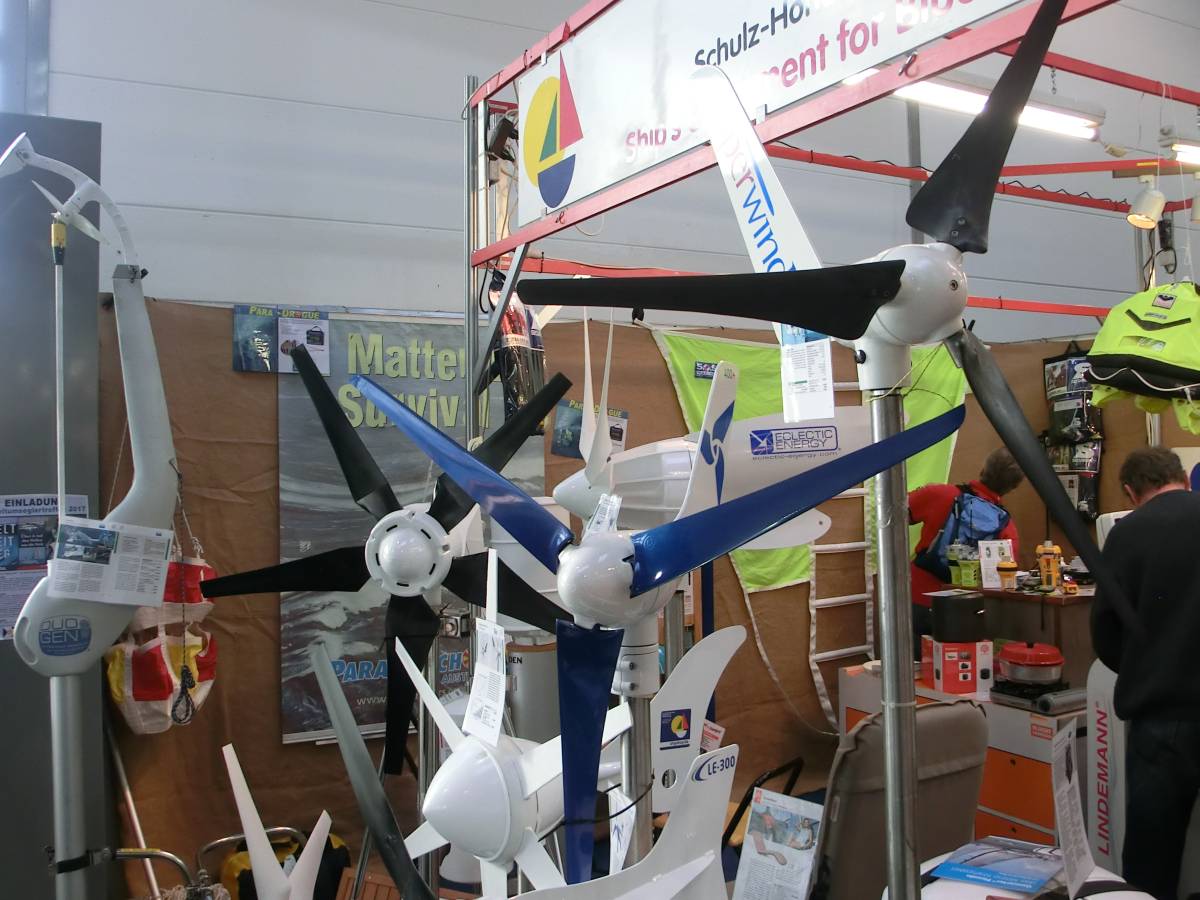
Photo: Mini wind turbines at the exhibition stand (Patrick Jüttemann)
A market consolidation like the one in the photovoltaics industry has not yet occurred. Not only are there a large number of suppliers, but there are also significant differences in the quality, market maturity, and efficiency of individual wind turbines.
That's why it's so important to take a closer look at wind turbines and companies and separate the wheat from the chaff. Manufacturers are usually small companies with series production of their turbines.
This also means: Good quality comes at a price. You won't be satisfied if that cheap wind turbine from the Far East gets dismantled at the first storm.
Please be careful and don't believe everything some providers say. Annual electricity yields are often greatly exaggerated. Misleading information about suitable installation locations for small wind turbines is also widespread.
Criteria for selecting good small wind turbines
Unlike countries like the USA or Japan, Germany does not have a quality label in the form of a certification standard for small wind turbines. The relevant technical standard is IEC 61400-2, which, among other things, requires extensive testing of wind turbines .
Conclusion: In Germany, most small wind turbines are not certified. This also applies to Austria and Switzerland. Does a small wind turbine have to be certified from a buyer's perspective? No, because there are many good manufacturers whose wind turbines are not certified. This doesn't make the market situation any easier for buyers or prospective buyers.
How can a buyer determine the quality of a small wind turbine?
You need independent references to verify that the wind generator will operate reliably over an extended period of time, outdoors in the open wind.
Such independent references can be:
- Certification according to IEC 61400-2
- Independent test field results according to IEC 61400-2
- Market readiness of the company and its products
- Assessment of independent experts
- Experiences of small wind turbine operators
For private use, small wind turbines with an output of up to around 5 kilowatts are used. Commercial businesses require (significantly) higher outputs depending on their electricity needs. Small wind turbines for decentralized power supply in Germany have a maximum output of 250 kilowatts.
Recommended manufacturers of small wind turbines from Germany
Aerocraft – Gödecke Energy and Propulsion Technology
Type: Horizontal rotor axis / upwind rotor / 3 or 5 rotor blades
Models & rated power:
Aerocraft AC 120 – 120 watts at 9 m/s
Aerocraft AC 240 – 240 watts at 9 m/s
Aerocraft AC 752 – 750 watts at 9 m/s
Aerocraft AC 1002 – 1000 watts at 9 m/s
Company headquarters:
27356 Rotenburg (Wümme)
Lower Saxony
The manufacturer at a glance:
The manufacturer has over 20 years of experience. The small wind turbines with a rated output of up to 1 kW are used by private and professional operators worldwide. The manufacturer focuses on minimizing moving parts and using corrosion-free materials to ensure the longest possible and maintenance-free operation. The wind turbines are primarily used for battery charging in stand-alone operation. They are also suitable for grid connection. The 1 kW model is optionally available with components for hot water production.
BestWatt BV (formerly Lely Aircon)
Type: Horizontal rotor axis / upwind rotor / 3 rotor blades
Models & rated power:
BW10 – 9.8 kW
BW45 – 45.0 kW
BW80 – 80.0 kW
Note: the BW45 and BW80 have the same rotor diameter of 15.9 m.
Company headquarters:
BestWatt BV
26789 Leer
Lower Saxony
The manufacturer at a glance:
BestWatt's small wind turbines have been on the market for over 17 years. Series production began in 2003 in East Frisia under the name Aircon, and production is still located there today. The 10 kW small wind turbine model has been installed over 200 times worldwide. The 30 kW wind turbine was launched in 2015 and has since been replaced by a 45 kW turbine. The turbine technology was designed for a service life of more than 20 years. A minimum of moving parts in the turbine results in low operating costs. Aerodynamic power regulation relies on the stall effect.
Braun Wind Turbines
Type: Horizontal rotor axis / upwind rotor / 3 rotor blades
Models & rated power:
ANTARIS 2.5 – 2.5 kW at 12 m/s
ANTARIS 3.5 – 3.5 kW at 12 m/s
ANTARIS 5.5 – 5.5 kW at 12 m/s
ANTARIS 7.5 – 7.5 kW at 12 m/s
ANTARIS 12.0 – 12.0 kW at 12 m/s
Company headquarters:
57583 Nauroth
Rhineland-Palatinate
The manufacturer at a glance:
Braun Windturbinen GmbH, based in the Westerwald region, has been developing and producing small wind turbines for over 20 years. According to the company, over 1,200 wind generators have been delivered. The export share is over 60%. To accommodate the wind conditions at different locations, rotor blades with different diameters and mast heights are offered for the individual ANTARIS wind turbines. With larger blades and higher masts, good electricity yields can be achieved even in inland areas with less windy conditions. Braun Windturbinen also supplies components and control systems for hot water generation using wind energy.
Easywind
Type: Horizontal rotor axis / upwind rotor / 4 rotor blades
Models & rated power:
EasyWind 6 AC – 6 kW at 10.6 m/s
EasyWind 6 DC – 7.5 kW at 11.5 m/s
Company headquarters:
25917 Enge – Sande,
Schleswig-Holstein
The manufacturer at a glance:
The EasyWind 6 with 6 kW output was developed back in 1984, and over 400 systems have since been installed worldwide. The wind generator is the first small wind turbine manufactured in Germany to receive certification according to the international standard IEC 61400-2. The first EasyWind series has been in operation in the Rhineland for over 25 years. The EasyWind has demonstrated high yields on a test field in Austria over the past few years. A patented rotor blade adjustment system enables operation at very high wind speeds. The system can be installed without a crane and within a single day.
Heyde Wind Technology
Type: Horizontal rotor axis / upwind rotor / 3 rotor blades
Models & rated power:
Heywind 2.5 – 2.5 kW at 11 m/s
Heywind 3.5 – 3.5 kW at 11 m/s
Heywind 5.0 – 5.0 kW at 11 m/s
Company headquarters:
01744 Dippoldiswalde
, Saxony
The manufacturer at a glance:
Heyde Windtechnik GmbH was founded in 2001. The Heywind is used for feeding energy into the household grid, for heating support, and for battery charging. For safety and power regulation, the turbine features a "helicopter position"; in strong winds, the rotor tilts backward. The Heywind is used in several countries worldwide and has proven itself in a variety of climatic conditions.
PSW energy systems
Type: Horizontal rotor axis / upwind rotor / 3 rotor blades
Models & rated power:
EN-Drive 2000.4/-MP – 8 kW at 10.3 m/s
EN-Drive 2000.4/10-MXP – 10 kW at 9.8 m/s
EN-Drive 2000.4/15-LP and LXP – 15 kW at 10.6 m/s
Company headquarters:
29227 Celle
, Lower Saxony
The manufacturer at a glance:
The company was founded in Celle in 2007. In addition to small wind turbines, its product range includes heat pumps and small CHP systems. In 2012, a new 1,000 m² production facility was built in Celle, and a new series of small wind turbine generators was introduced at the same time. A unique technological feature of PSW small wind turbines is the installation of the generator and electronics in the substructure of the turbine, rather than in the nacelle as is usual. Mechanical power transmission is achieved via a shaft located in the tubular steel mast.
Solutions 4 Energy
Type: Horizontal rotor axis / upwind rotor / 3 rotor blades
Models & rated power:
S4E 30K16 – 30 kW at 9 m/s (16 m rotor)
S4E 30K20 – 30 kW at 9 m/s (20 m rotor)
Company headquarters:
18057 Rostock,
Mecklenburg-Western Pomerania
The manufacturer at a glance:
Testing of the wind turbine began in spring 2018 in Sankt Michaelisdonn near Hamburg. Full certification based on the IEC 61400-1 standard is expected in the course of 2020. The rotors, which are large relative to their rated power, feature active central rotor blade adjustment, thus generating high yields even in light wind conditions. The rotor blade design makes the turbine very quiet. The gearless generator reduces the number of potentially failure-prone components. In addition to feeding into the grid, the wind turbine can be used for decentralized self-sufficiency. The turbine is capable of black start and can be used without a grid connection, even in remote areas.
Superwind
Type: Horizontal rotor axis / upwind rotor / 3 rotor blades
Models & rated power:
Superwind 350 – 350 watts at 12.5 m/s
Superwind 1250 - 1.25 kW at 11.5 m/s
Company headquarters:
50321 Brühl
NRW
The manufacturer at a glance:
The development of the Superwind 350 dates back to the year 2000. The company, based near Cologne, was founded in 2004. The wind turbine was developed for reliable power generation under extreme conditions. This includes operation at sea, such as for navigational aids and other professional offshore installations. Private use is also common, for example, for mobile homes, vacation homes, or sailboats. These small wind generators exhibit a very high technical standard for their power class. One technical refinement is the aerodynamic rotor control.
S & W Energy Systems
Type: Horizontal rotor axis / upwind rotor / 3 rotor blades
Models & Rated Power:
S&W 6.0 - 6.0 kW at 10.0 m/s
S&W 15.0 - 15.0 kW at 10.3 m/s
Company headquarters:
37269 Eschwege,
Hesse
The manufacturer at a glance:
The company was founded in 2005. S & W Energiesysteme is a systems provider for hybrid systems including solar systems, small wind turbines, and battery storage systems, as well as the associated planning services such as the development of energy concepts. The first customer system went into operation in 2010. The repeller blades are manufactured in-house by S & W Energiesysteme and are therefore particularly well-suited to the drive train. Power limitation is achieved through stall control (flow separation at the rotor blade) and sidefacing (wind pressure turns the rotor to the side).
Wind Technology North
Type: Horizontal rotor axis / upwind rotor / 3 rotor blades
Models & Rated Power:
WTN250i - 250 kW at 14 m/s
Company headquarters:
25917 Enge-Sande,
Schleswig-Holstein
The manufacturer at a glance:
Founded in 1986, the company boasts over three decades of experience in the wind power industry. It manufactures wind turbines with an output of between 250 and 600 kW, in the medium-power range. The exception is the WTN250i model, which, with a total height of less than 50 m, is classified as a small wind turbine for regulatory purposes. The basic technical platform of the WTN 250i, introduced in 2019, is the WTN250, which has been built over 100 times and developed for the international market. The key difference in the i variant is the full-scale converter, which ensures compliance with specific technical standards and grid feed-in requirements, as in Germany.
WWA Weinack wind turbines
Type: Horizontal rotor axis / upwind rotor / 3 rotor blades
Models & Rated Power:
Falcon40 - 7.5 kW at 10.0 m/s
Company headquarters:
22880 Wedel,
Schleswig-Holstein
The manufacturer at a glance:
Founded in 2014, the manufacturer of a small wind turbine with a nominal output of 7.5 kW has proven the quality of its system technology on a strong wind test field (7.5 m/s annual average) in Denmark. Starting in January 2014, a wind turbine was tested for a year, and its performance and noise levels were measured. All components are manufactured in Germany, and the rotor blades are produced in Denmark. Overall, the wind turbine, designed in accordance with the Machinery Directive, is very robust and includes vibration isolation.